Anglican — Order, Beauty, and the Tension That Never Resolved
Jun 22, 2026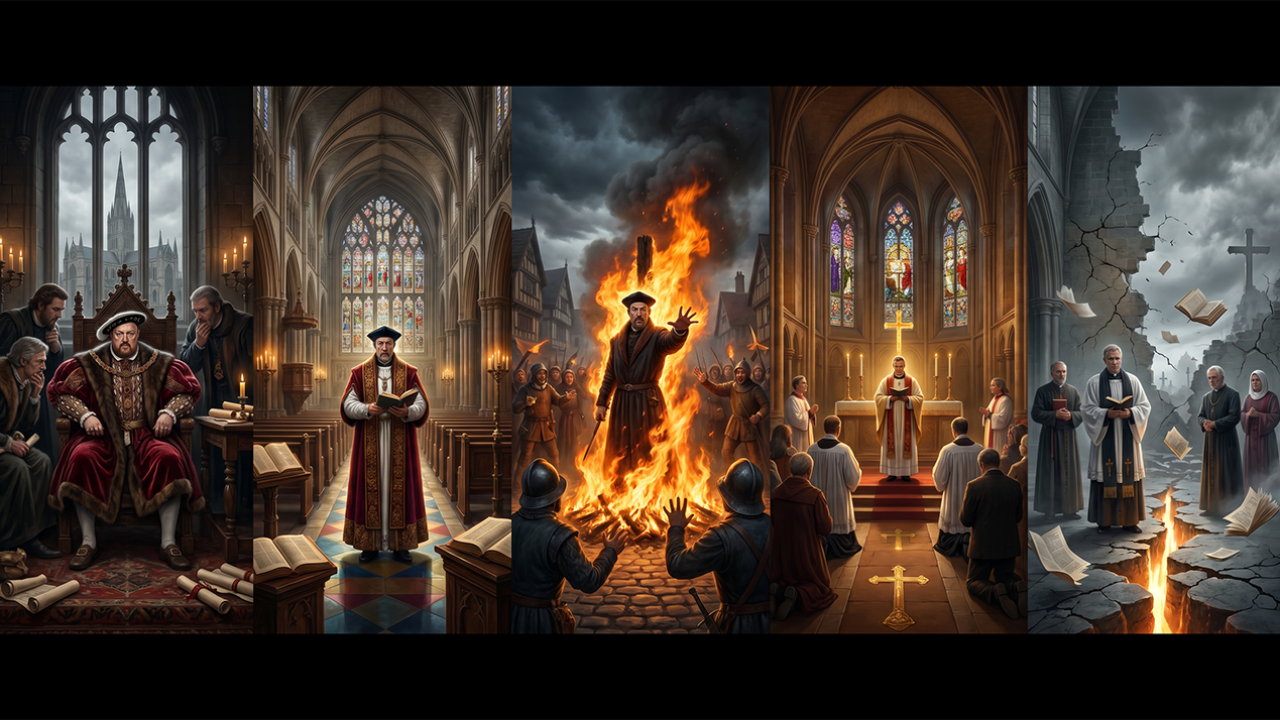
This is article 7 in the Series: Know What You Believe and Why - KNOW YOUR ROOTS: A Plain-Language Guide to the Major Christian Traditions
The Church That Was Born in a Divorce
Most Christian traditions were founded on a theological conviction. The Anglican Church was founded on a political crisis. That is not entirely fair — the theology came, and it came seriously — but it is not entirely wrong either, and any honest account of Anglicanism has to start there.
In 1534, King Henry VIII of England wanted an annulment from his wife, Catherine of Aragon. Pope Clement VII would not grant it. Henry's response was to declare himself the Supreme Head of the Church of England, sever ties with Rome, and proceed with the annulment on his own authority. The Church of England was born.
Henry was not a Protestant. He did not share Luther's theology. He executed Protestants and Catholics alike when they got in his way. But the break with Rome he created opened a door, and through that door walked a generation of genuine reformers — Thomas Cranmer, Nicholas Ridley, Hugh Latimer — who shaped the Church of England into something theologically serious.
Understanding Anglicanism means holding two things simultaneously: the messy, politically compromised origins and the genuine theological substance that developed despite them. It is a tradition that has been doing that balancing act for five hundred years.
The Via Media
The phrase that defines Anglican identity is via media — the middle way. From the beginning, the Church of England positioned itself between Roman Catholicism and the more radical Protestant reformers. It kept bishops and liturgy and a structured sacramental life. It also embraced Protestant theology — justification by faith, the authority of Scripture, the rejection of papal authority.
The result is a tradition that is genuinely difficult to categorize. High church Anglicans — Anglo-Catholics — emphasize the Catholic elements: the sacraments, the apostolic succession of bishops, the liturgical tradition. Low church Anglicans emphasize the Protestant elements: the authority of Scripture, the centrality of preaching, the simplicity of worship. Broad church Anglicans try to hold the middle and are sometimes accused of holding nothing at all.
This is not a bug in Anglican theology. It is, in the Anglican view, a feature. The via media is a deliberate attempt to preserve the best of the Catholic tradition while embracing the Protestant reformation of doctrine. Whether it succeeds depends significantly on who is doing the preserving.
The Book of Common Prayer
If there is one artifact that defines Anglican identity more than any other, it is the Book of Common Prayer. Thomas Cranmer, Archbishop of Canterbury under Henry VIII and Edward VI, compiled the first Book of Common Prayer in 1549. It was a liturgical masterpiece — a structured order of worship that drew on ancient Christian practice, translated into English, and made accessible to ordinary people.
The Prayer Book gave Anglicanism its distinctive character: worship that is ordered, beautiful, and participatory. The congregation speaks. The congregation prays. The congregation confesses together and receives absolution together. The rhythms of the Christian year — Advent, Christmas, Epiphany, Lent, Easter, Pentecost — structure the life of the church and the life of the believer.
Cranmer was burned at the stake in 1556 under the Catholic Queen Mary. Before he died, he thrust the hand that had signed a recantation into the flames first, saying it should be punished for its weakness. The man who gave Anglicanism its liturgical voice died with the kind of courage that makes you take his theology seriously.
The Prayer Book has been revised multiple times across multiple Anglican provinces, and the revisions have not always been improvements. But the original instinct — that worship should be ordered, that beauty serves truth, that the whole congregation participates rather than watches — is a genuine contribution to Christian practice.
What Anglicanism Gets Right
The Anglican tradition takes the Incarnation seriously in a way that shapes its entire approach to worship and life. If God became flesh — if the physical world is the arena of divine action — then beauty matters, order matters, the body matters. Worship that engages the senses, that moves through the rhythms of the Christian year, that connects the believer to the historic community of faith across time, is not mere aestheticism. It is a theological statement about the nature of reality.
The Anglican emphasis on the Christian year is also worth recovering for men who have grown up in traditions where Sunday is essentially the same every week. Advent prepares. Christmas celebrates. Lent confronts. Easter transforms. Pentecost sends. Moving through those seasons together as a community shapes a man's spiritual life in ways that a steady diet of topical sermon series does not.
The Anglican tradition has also produced some of the most significant Christian thinkers and writers in the English language. C.S. Lewis was Anglican. John Stott was Anglican. N.T. Wright is Anglican. The tradition has a serious intellectual heritage that is worth engaging.
Where It Gets Complicated
The Anglican tradition's greatest strength — its commitment to holding things together — is also its greatest vulnerability. A tradition that defines itself by the middle way has a structural difficulty saying no. And when the pressure to accommodate cultural change becomes intense enough, the via media can become a via to anywhere.
The Anglican Communion — the global network of Anglican churches — has been in open crisis for two decades over sexuality and ordination. The Episcopal Church in the United States, the American expression of Anglicanism, has moved decisively in a direction that most of the global Anglican Communion — particularly in Africa and Asia — regards as a departure from Scripture. The result has been a formal fracture, with conservative Anglican churches in the United States aligning with African provinces rather than with the Episcopal Church.
This is not a peripheral dispute. It is a dispute about whether Scripture or cultural consensus is the final authority — which is, at its core, the same dispute that drove the Reformation. The Anglican tradition has been here before. The question is whether it has the theological resources to find its way back.
The apostolic succession — the Anglican claim that its bishops stand in an unbroken line of ordination from the apostles — is also worth examining honestly. The Catholic Church does not recognize Anglican orders as valid. Many Protestant traditions regard the claim as theologically unnecessary. The Anglican tradition holds it as significant. Whether it is significant depends on what you believe about the nature of the church and the authority of ordained ministry — questions that Anglicanism has never fully resolved.
Practical Applications
Recover the Christian year. You do not have to be Anglican to benefit from moving through Advent, Lent, and Easter with intentionality. The rhythms of the Christian year are a formation tool that most evangelical men have never been given. Consider using them.
Take liturgy seriously. The instinct that worship should be ordered and that the congregation should participate actively — not just observe — is a biblical instinct. The New Testament describes a community that prays together, confesses together, and speaks to one another in psalms and hymns and spiritual songs. Liturgy, done well, is that instinct given form.
Engage the Anglican intellectual tradition. If you have never read C.S. Lewis seriously, start. If you have never read John Stott on the cross or N.T. Wright on the resurrection, you are missing some of the best biblical scholarship available in English. The tradition has produced serious thinkers. Use them.
Hold the line on Scripture. The Anglican crisis is a warning. A tradition that defines itself by holding things together will eventually face a moment when holding things together requires compromising the Word. That is the moment that defines whether a tradition has a center or just a style.
The Closing Charge
The Anglican tradition is five hundred years old, born in political compromise, shaped by genuine theological courage, and currently navigating a crisis that will determine whether it has a future worth having.
At its best, it offers something that much of evangelical Christianity has lost: a sense that worship is ordered and beautiful, that the Christian life moves through seasons, that the community of faith stretches backward through history and forward into eternity, and that the physical and the spiritual are not enemies.
At its worst, it offers a Christianity so committed to holding the middle that it cannot hold the line.
The men who built it — Cranmer, Ridley, Latimer, burning at the stake for what they believed — did not die for the middle way. They died for the truth. That is the Anglican tradition worth recovering.
Stop Drifting
You already know what happens if you do nothing.
A year from now,
you’ll either: