
Dirt Doesn't Lie — The Archaeological Case for the Bible
Oct 19, 2026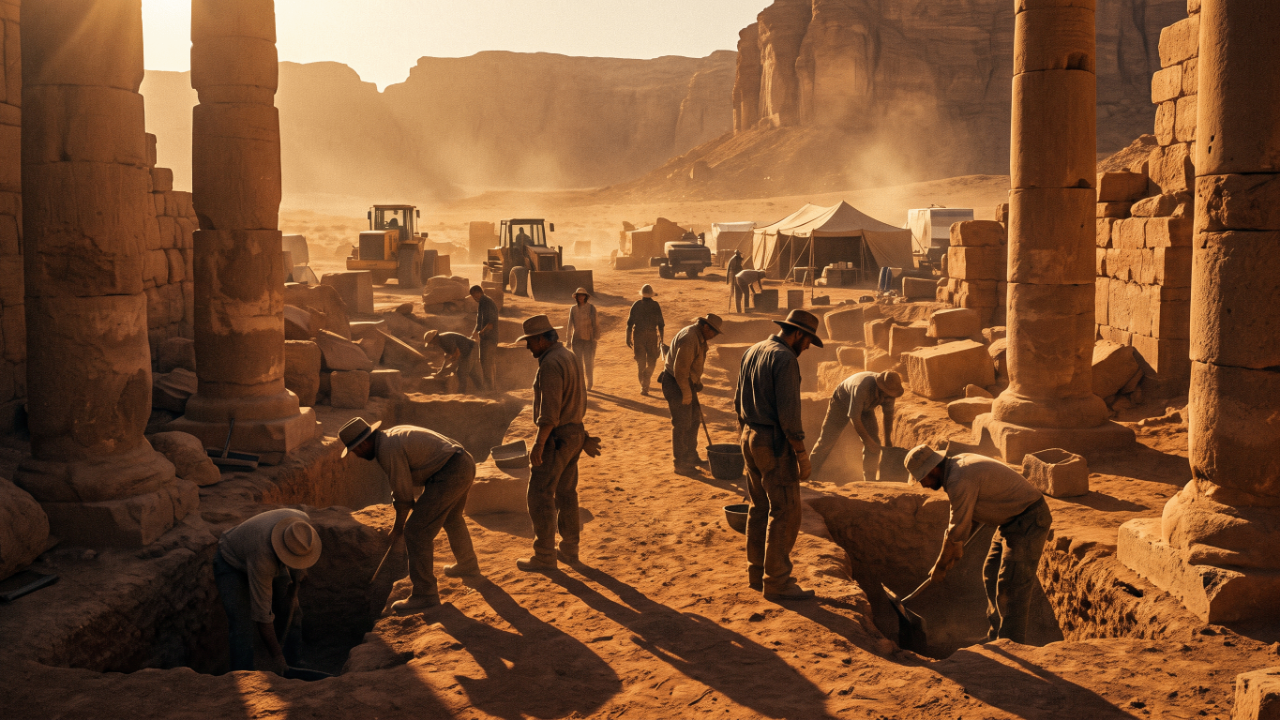
Part of the Series: Know What You Believe and Why
The Confident Dismissal
For most of the 19th century, the academic consensus on the historical reliability of the Bible was not favorable. The patriarchs were legendary figures. The Exodus was mythology. King David was a folk hero with no more historical reality than King Arthur. The cities described in the conquest narratives had never existed. The empires the Bible described as Israel's enemies were either unknown or their interactions with Israel were unverifiable.
The scholars who held these positions were not stupid. They were working with the evidence available to them. The problem was that the evidence available to them was incomplete — and the ground beneath their feet was full of things they had not yet dug up.
Archaeology has a way of humbling confident dismissals. Over the past 150 years, the spade has repeatedly confirmed what the critics said could not be confirmed. People dismissed as legendary have turned up in inscriptions. Cities dismissed as fictional have been excavated. Events dismissed as invented have been corroborated by independent sources. The pattern is consistent enough that it is no longer possible for an honest historian to dismiss the Bible's historical claims on the grounds that they are unverifiable.
The Hittites
For most of the 19th century, the Hittites — a people mentioned dozens of times in the Old Testament — were unknown outside the Bible. Critics pointed to this as evidence that the biblical writers had invented them. There was no archaeological, historical, or textual evidence for a Hittite civilization.
In 1876, British scholar Archibald Henry Sayce proposed that certain inscriptions found in Turkey and Syria were Hittite. In 1906, excavations at Hattusa in modern Turkey uncovered the Hittite capital — a major Bronze Age civilization with its own language, law codes, and extensive diplomatic correspondence. The Hittite Empire, it turned out, had been one of the great powers of the ancient Near East, a rival to Egypt, with a history spanning roughly 700 years.
The people the critics said did not exist had left behind an entire capital city.
Belshazzar
The book of Daniel describes Belshazzar as the king of Babylon on the night the city fell to the Persians. For centuries, critics pointed out that Babylonian records listed Nabonidus as the last king of Babylon — not Belshazzar. Daniel, they argued, had gotten the history wrong.
In 1854, excavations at Ur uncovered the Nabonidus Cylinder — an inscription in which Nabonidus prays for the health of his eldest son, Belshazzar, whom he had appointed as co-regent while he campaigned in Arabia. Belshazzar was not the king of Babylon in the sense of holding the official title — Nabonidus was. But he was the acting ruler in Babylon, which explains why Daniel 5:16 offers Daniel the position of "third highest ruler in the kingdom" — not second, because Nabonidus was first and Belshazzar was second.
The detail that critics said proved Daniel was historically unreliable turned out to be a detail that proved Daniel was historically precise.
The Pool of Bethesda
The Gospel of John describes Jesus healing a man at the Pool of Bethesda in Jerusalem — a pool with five covered colonnades. For centuries, no such pool had been found, and some scholars argued that the detail was symbolic rather than historical — that John had invented a location to make a theological point.
In the 19th century, excavations near the Church of Saint Anne in Jerusalem uncovered a pool with five colonnades, exactly matching John's description, at a depth of approximately 13 meters below the current street level. The pool is now a standard stop on archaeological tours of Jerusalem.
The pool John described was not a theological invention. It was a real place that had been buried under centuries of construction.
The Tel Dan Stele
One of the most significant archaeological discoveries of the 20th century for biblical studies was made in 1993 at Tel Dan in northern Israel. Excavators found fragments of a basalt stele — an inscribed stone monument — containing an Aramaic inscription from the 9th century BC. The inscription, written by an Aramean king celebrating a military victory, contains the phrase bytdwd — "House of David."
This was the first extrabiblical inscription ever found that explicitly referenced the House of David — confirming that David was a historical figure significant enough to have a dynasty named after him in the records of his enemies. The discovery was significant enough that the New York Times ran a front-page story on it.
King David — the man critics had compared to King Arthur as a legendary figure with no historical basis — had left his name in the archaeological record of his enemies.
Pontius Pilate
The New Testament identifies Pontius Pilate as the Roman prefect of Judea who authorized the crucifixion of Jesus. For centuries, Pilate was known only from the New Testament and a handful of references in Roman historians. Some critics questioned whether he had held the specific title the New Testament implied.
In 1961, Italian archaeologists excavating the ancient theater at Caesarea Maritima found a limestone block with a Latin inscription. The inscription, now known as the Pilate Stone, reads in part: "Pontius Pilatus, Prefect of Judaea." It is the only archaeological artifact ever found that directly names Pontius Pilate and confirms his title.
The man who sentenced Jesus to death left his name in stone at the theater he dedicated to the Emperor Tiberius.
The Pattern
These are not isolated examples. They are representative of a consistent pattern across 150 years of biblical archaeology. Nelson Glueck, one of the most respected archaeologists of the 20th century and not a Christian apologist, wrote: "It may be stated categorically that no archaeological discovery has ever controverted a biblical reference."
That is a strong statement. It is not universally accepted — there are genuine archaeological debates about specific biblical claims, and honest scholarship acknowledges them. But the overall pattern — of archaeological discovery repeatedly confirming biblical details that critics had dismissed as legendary or invented — is not seriously disputed.
The Bible is not a perfect archaeological textbook. It was not written as one. But it is a document whose historical claims have survived archaeological scrutiny far better than its critics predicted and far better than most people know.
Practical Applications
Know three or four examples cold. The Hittites. Belshazzar. The Pool of Bethesda. The Tel Dan Stele. The Pilate Stone. You do not need to know all of them. You need to know enough to make the point that archaeological discovery has repeatedly confirmed biblical details that critics dismissed.
Know the Glueck quote. Nelson Glueck was not a Christian apologist. He was one of the most respected archaeologists of the 20th century. His statement that no archaeological discovery has ever controverted a biblical reference is worth knowing and citing.
Acknowledge the genuine debates. There are legitimate archaeological debates about specific biblical claims — the scale of the Exodus, the nature of the conquest of Canaan, the extent of Solomon's kingdom. Acknowledging these honestly makes your case stronger, not weaker. You are not arguing for biblical inerrancy on archaeological grounds. You are arguing that the pattern of confirmation is significant.
Visit the evidence. The Israel Museum in Jerusalem houses the Dead Sea Scrolls, the Pilate Stone, and dozens of other artifacts that confirm biblical history. If you ever have the opportunity to go, go. Seeing the physical evidence changes something in a man.
The Closing Charge
Dirt does not lie. It does not have a theological agenda. It does not care whether the Bible is true or false. It simply holds what was buried in it until someone digs it up.
What has been dug up — over 150 years of systematic archaeological work across the ancient Near East — is a consistent pattern of confirmation. The people the critics said were legendary. The cities the critics said were fictional. The rulers the critics said were invented. The pools the critics said were symbolic. All of them, turning up in the ground.
The Bible's historical claims have survived the scrutiny of the spade better than any of its critics predicted. That is not proof of divine inspiration. It is evidence of historical reliability — and it is evidence that every Christian man should know how to present.
The ground has been speaking for 150 years. It is time more of us learned to listen.
Stop Drifting
You already know what happens if you do nothing.
A year from now,
you’ll either: