Eastern Orthodox — The Church That Refused to Change
Jul 05, 2026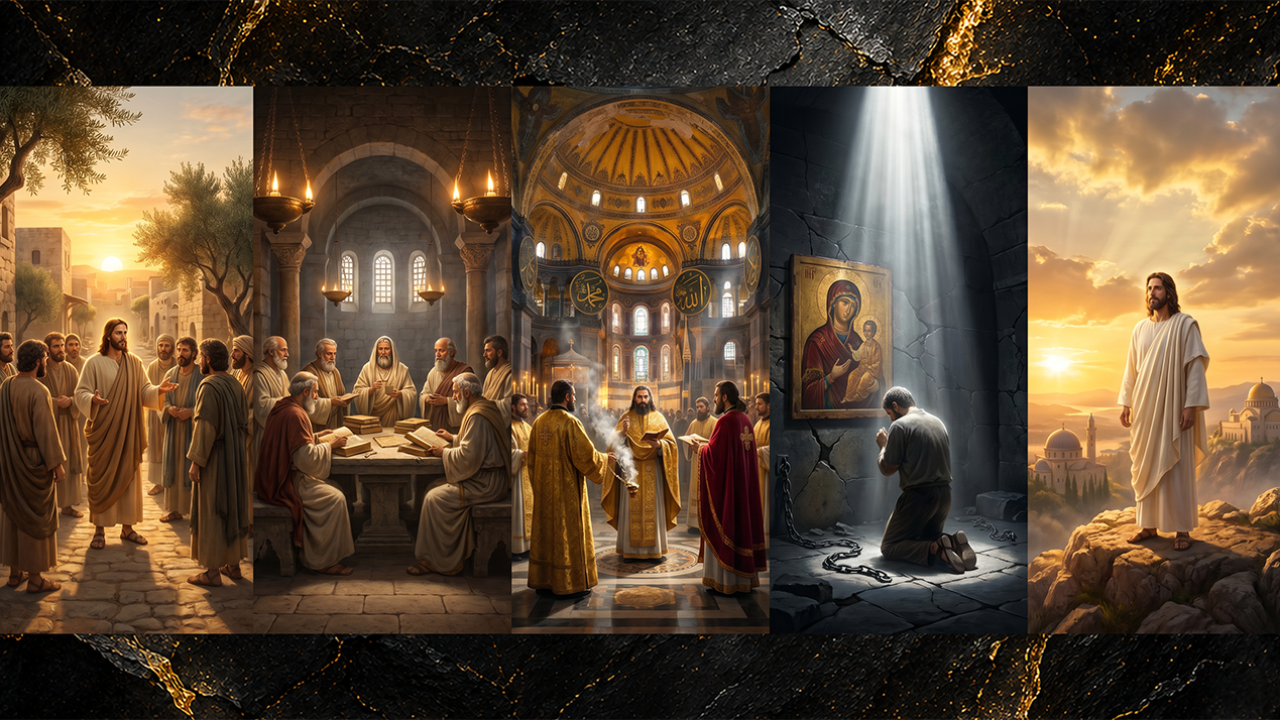
This is article 9 in the Series: Know What You Believe and Why - KNOW YOUR ROOTS: A Plain-Language Guide to the Major Christian Traditions
The Room Most Protestants Have Never Entered
There is a church that has been holding the same liturgy for over a thousand years. It has never had a Reformation. It has never issued a new doctrinal statement. It does not have a pope. It does not have a denominational headquarters in the American sense. It has bishops, and priests, and deacons, and a theology so ancient and so dense that most Western Christians — Protestant and Catholic alike — have never seriously engaged it.
The Eastern Orthodox Church claims to be the original church. Not a branch of it. Not a continuation of it. The thing itself, unbroken, from the apostles to the present day.
That is a serious claim. It deserves a serious look.
Most evangelical men have never been in an Orthodox church. The incense, the icons, the chanting, the liturgy in a language they do not recognize — it feels foreign. It feels, frankly, like something that has nothing to do with them. That reaction is understandable. It is also worth pushing past. Because the Eastern Orthodox tradition is asking questions about the nature of the church, the authority of Scripture, and the meaning of salvation that every serious Christian man should be able to engage.
The Split That Shaped Everything
To understand Orthodoxy, you have to understand 1054 AD. That is the year of the Great Schism — the formal break between the Eastern and Western branches of the Christian church. It had been building for centuries. Theological disputes, political tensions, competing claims of authority between the Pope of Rome and the Patriarch of Constantinople. When it finally broke, it broke clean.
The Western church became what we now call the Roman Catholic Church. The Eastern church became what we now call the Eastern Orthodox Church. Both claim to be the legitimate continuation of the original apostolic church. Both have been making that argument for a thousand years.
The Protestant Reformation in the 16th century was entirely a Western event. Luther, Calvin, Zwingli — they were all reacting against Rome. The Eastern church watched from a distance, largely unaffected. It had no pope to rebel against. It had no indulgences to protest. It had its own problems, but the specific problems that drove the Reformation were not among them.
This means that when Protestants argue about the authority of the pope or the sale of indulgences or justification by faith alone, the Orthodox theologian looks on with a kind of detached curiosity. Those are Western arguments about Western problems. Orthodoxy was never part of that conversation.
That distance is worth understanding. It means the Orthodox tradition represents a genuinely different stream of Christian thought — one that predates the Catholic-Protestant divide entirely.
What Orthodox Christians Actually Believe
Start with the foundation, because it is solid. Eastern Orthodoxy affirms the Nicene Creed without reservation. The Trinity. The full divinity and full humanity of Christ. The virgin birth. The physical resurrection. The ascension. The return of Christ. On every core doctrine established by the early ecumenical councils — councils that both East and West participated in — Orthodoxy stands firm.
Where it diverges from Protestant Christianity is in three significant areas.
Scripture and Tradition. Like Catholicism, Orthodoxy does not hold to Sola Scriptura. Scripture and Holy Tradition are understood as two expressions of a single divine revelation. But the Orthodox understanding of Tradition is different from the Catholic one. There is no single authoritative interpreter — no pope, no Magisterium. Tradition is the living consensus of the church across time, expressed through the ecumenical councils, the writings of the Church Fathers, the liturgy, and the ongoing life of the community. The Protestant concern — that Tradition becomes a mechanism for overriding Scripture — is a legitimate one. The Orthodox response is that Scripture itself emerged from the Tradition of the church, and that separating the two creates more problems than it solves.
Salvation as Theosis. This is where Orthodoxy is most distinct and most worth understanding. Western Christianity — both Catholic and Protestant — has tended to frame salvation primarily in legal terms. Sin is a crime. The penalty must be paid. Justification is the declaration that the penalty has been satisfied. This is not wrong. But it is, in the Orthodox view, incomplete.
The Orthodox understanding of salvation is theosis — a Greek word meaning deification or divinization. The goal of the Christian life is not merely to be forgiven. It is to be transformed. To participate in the divine nature, as 2 Peter 1:4 describes it. To become, by grace, what God is by nature. This is not the heresy it might sound like to Protestant ears. It is not the claim that man becomes God in essence. It is the claim that genuine salvation produces genuine transformation — that the Christian life is a process of being conformed to the image of Christ that does not end at conversion but continues through death and into eternity.
C.S. Lewis, who was Anglican but deeply influenced by Orthodox thought, described something close to this in Mere Christianity when he wrote about God's intention to turn men into "a new kind of man." The Orthodox tradition has been saying that for fifteen centuries.
The Sacraments. Orthodoxy holds a high sacramental theology. Baptism, Chrismation (confirmation), and the Eucharist are not merely symbolic. They are genuine means of grace — moments where God acts in and through physical elements to accomplish spiritual transformation. Infant baptism is practiced. The Eucharist is understood as the true body and blood of Christ, though the Orthodox deliberately avoid the Western philosophical language of transubstantiation to describe how.
What Orthodoxy Gets Right
The Orthodox tradition has preserved something that much of Western Christianity — and especially American evangelical Christianity — has largely lost: a sense of the weight and antiquity of the faith.
When an Orthodox Christian stands in the Divine Liturgy, he is participating in a form of worship that connects him directly to the early church. The prayers he prays are the prayers of men who knew the apostles. The theology he confesses was hammered out in councils attended by men who had been tortured for their faith. There is a gravitas to that continuity that is genuinely formative.
The emphasis on theosis is also a corrective that Protestant men need to hear. A Christianity that is satisfied with justification and indifferent to transformation is not the Christianity of the New Testament. Paul's language in Romans 8, in 2 Corinthians 3, in Philippians 3 — the language of being conformed to the image of Christ, of pressing toward the goal, of the Spirit transforming us from one degree of glory to another — is the language of theosis, even if Paul does not use that word. The Orthodox tradition has kept that vision of the Christian life alive with a clarity that much of evangelical Christianity has traded for a thinner gospel.
The Orthodox commitment to the Church Fathers is also worth taking seriously. Ignatius of Antioch. Athanasius. Basil the Great. John Chrysostom. These men were closer to the apostles than we are. They read the same texts in the original language. They died for the same faith. A tradition that has maintained serious engagement with their writings across fifteen centuries has access to a depth of theological reflection that a tradition built on Sunday morning sermons and topical Bible studies simply does not.
Where It Gets Complicated
The authority question is the central challenge. If Scripture and Tradition are co-equal sources of divine revelation, and if Tradition is defined as the living consensus of the church, then the question becomes: who determines what the consensus is? The Orthodox answer — the ecumenical councils — is historically grounded but practically limited. There have been seven ecumenical councils recognized by Orthodoxy, the last of which was in 787 AD. The church has been navigating doctrinal questions without that mechanism for over twelve hundred years.
The result is that Orthodoxy, for all its emphasis on unity and consensus, is not a monolith. There are jurisdictional disputes, ethnic divisions, and theological disagreements that the tradition has never fully resolved. The relationship between the various national Orthodox churches — Greek, Russian, Serbian, Antiochian, Romanian — is complicated, and the question of who speaks for Orthodoxy in any given moment is not always clear.
The iconography and veneration of saints also creates genuine friction for Protestant men. The Orthodox distinction between veneration of icons and worship of God is theologically careful. The argument — that icons are windows into the heavenly reality, not objects of worship in themselves — is serious and has been defended by serious theologians. But the line between veneration and worship is one that many ordinary Orthodox Christians navigate imperfectly, and the Protestant concern is not without basis.
The insularity of some Orthodox communities is also worth naming. The ethnic character of many Orthodox parishes — Greek Orthodox, Russian Orthodox, Serbian Orthodox — can make them feel like cultural clubs rather than missionary communities. The Great Commission does not appear to be the driving engine of most Orthodox parish life in the West. That is a real weakness.
Practical Applications
Understand the Great Schism. 1054 AD is one of the most important dates in Christian history and most Protestant men have never heard of it. Knowing what split, why it split, and what each side claimed gives you a far more complete picture of the Christian tradition than the Reformation-only narrative provides.
Take theosis seriously. You do not have to be Orthodox to recognize that the Western church has often settled for a thin gospel — one that gets men to conversion and then leaves them largely unchanged. The Orthodox vision of salvation as ongoing transformation is a biblical vision. Engage it. Let it challenge the adequacy of your own formation.
Read the Church Fathers. Athanasius on the Incarnation is a short book that will change how you think about Christmas. John Chrysostom on the priesthood will change how you think about leadership. These men are not Orthodox property. They belong to the whole church. Use them.
Hold the line on Scripture. Respect for the Orthodox tradition does not require accepting the co-equal authority of Tradition alongside Scripture. The Protestant instinct — that Scripture must be the final check on any human institution, including the church — is correct. You can honor fifteen centuries of theological reflection without surrendering the principle that produced the Reformation.
The Closing Charge
The Eastern Orthodox Church has been holding the same liturgy, confessing the same creed, and pursuing the same vision of transformation for fifteen centuries. It has survived the fall of Constantinople, the Ottoman Empire, Soviet persecution, and the relentless pressure of Western secularism. It has produced theologians, martyrs, and saints whose depth of faith puts most comfortable Western Christianity to shame.
It has also never had a Reformation. And there are reasons for that — some of them strengths, some of them weaknesses — that every serious Christian man should understand.
The oldest room in the Eastern house is worth entering. Walk in with your eyes open, your Bible in hand, and enough humility to recognize that the church was doing serious theological work for a thousand years before the tradition you grew up in existed.
What you find there will not answer every question. It will sharpen the ones worth asking.
Stop Drifting
You already know what happens if you do nothing.
A year from now,
you’ll either: