What They Actually Built — The Founding Fathers, God, and the Nation We Were Meant to Be
Jul 03, 2026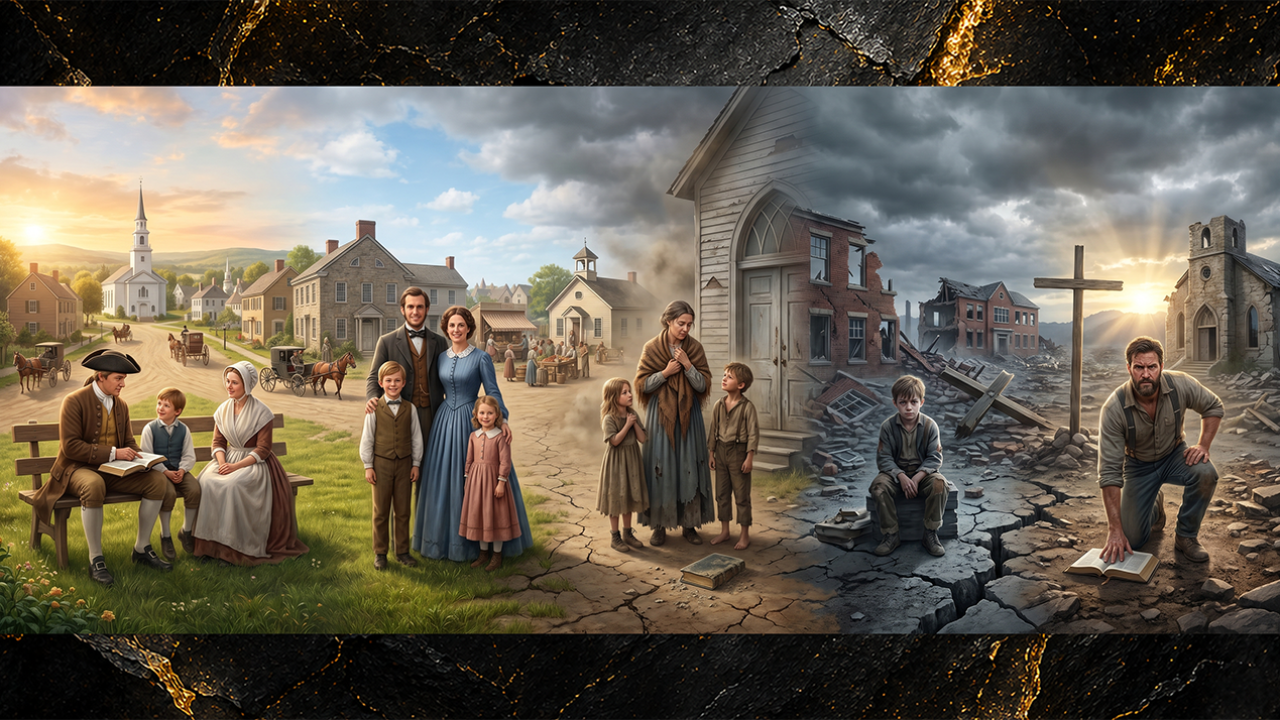
The Document Nobody Reads Carefully Enough
Most Americans have heard the Declaration of Independence quoted. Very few have sat with it long enough to feel the full weight of what it actually claims.
"We hold these truths to be self-evident, that all men are created equal, that they are endowed by their Creator with certain unalienable Rights, that among these are Life, Liberty and the pursuit of Happiness."
Read that again. Slowly.
The founders did not say rights come from the government. They did not say rights come from the majority. They did not say rights are negotiated, granted, or subject to revision by whoever holds power at the moment. They said rights come from the Creator. From God. And because they come from God, no government on earth has the authority to take them away.
That is not a political statement. That is a theological one. And it was the theological foundation on which the entire American experiment was built.
Two hundred and fifty years later, we have largely forgotten that. The consequences are visible everywhere.
Who These Men Actually Were
The revisionist project of the last several decades has worked hard to strip the founders of their faith. They were deists, we are told. Enlightenment rationalists who used religious language for political purposes but privately believed in a distant, uninvolved God who wound up the universe and walked away.
The historical record does not support that narrative.
George Washington, in his first inaugural address, said: "It would be peculiarly improper to omit in this first official act my fervent supplications to that Almighty Being who rules over the universe, who presides in the councils of nations, and whose providential aids can supply every human defect."
He did not stop there. In his Farewell Address — the document he chose as his final word to the nation he had built — Washington wrote: "Of all the dispositions and habits which lead to political prosperity, religion and morality are indispensable supports. In vain would that man claim the tribute of patriotism who should labor to subvert these great pillars of human happiness."
Indispensable. That is not the language of a man who thought faith was a private preference.
John Adams was equally direct. "Our Constitution was made only for a moral and religious people. It is wholly inadequate to the government of any other." He wrote to the officers of the First Brigade of the Third Division of the Militia of Massachusetts in 1798: "We have no government armed with power capable of contending with human passions unbridled by morality and religion."
Adams understood something that the modern secular mind refuses to accept: self-governance requires self-governed men. And self-governed men require a moral foundation that only God can provide.
Benjamin Franklin, often cited as the most skeptical of the founders regarding orthodox Christianity, stood before the Constitutional Convention in 1787 and said this: "I have lived, Sir, a long time, and the longer I live, the more convincing proofs I see of this truth — that God governs in the affairs of men. And if a sparrow cannot fall to the ground without His notice, is it probable that an empire can rise without His aid? We have been assured, Sir, in the Sacred Writings, that except the Lord build the house, they labor in vain that build it."
Franklin was quoting Psalm 127. At the Constitutional Convention. Because he believed it was true.
Patrick Henry, whose voice lit the fire of revolution, was unambiguous: "It cannot be emphasized too strongly or too often that this great nation was founded, not by religionists, but by Christians — not on religions, but on the Gospel of Jesus Christ."
Samuel Adams, the architect of the revolution, wrote: "The rights of the colonists as Christians may be best understood by reading and carefully studying the institutes of the great Lawgiver and Head of the Christian Church, which are to be found clearly written and promulgated in the New Testament."
These were not men using religious language as political decoration. These were men who believed that God had ordained this nation, that its freedoms were His gift, and that its survival depended on its people remaining accountable to Him.
What They Built and Why It Worked
The American system of government is unlike anything that had existed before it. The founders knew that. They also knew why it was possible.
They had a specific view of human nature — one drawn directly from Scripture. Man is fallen. Man is capable of great good and catastrophic evil. Power concentrated in any single human being or institution will eventually be abused, because human beings are not God and should not be trusted with unchecked authority.
This is why they built a system of checks and balances. Not because they were clever political engineers. Because they believed Genesis 3. They knew what men were capable of when accountability was removed.
They also built a system that assumed a specific kind of citizen. Not a perfect citizen. A moral one. A citizen who governed his own appetites, told the truth, kept his word, and understood that his freedom came with responsibility to God and neighbor.
Alexis de Tocqueville, the French political philosopher who toured America in the 1830s and wrote the most penetrating analysis of the American experiment ever produced, saw this clearly. "Liberty cannot be established without morality, nor morality without faith," he wrote. And: "America is great because she is good. If America ceases to be good, America will cease to be great."
The founders built a republic. They were explicit that it could only survive in the hands of a virtuous, God-fearing people. They were not naive about what would happen if that foundation eroded.
They were right.
How Far We Have Drifted
In 1962, the Supreme Court ruled in Engel v. Vitale that a brief, voluntary, nondenominational prayer in public schools was unconstitutional. The prayer in question read: "Almighty God, we acknowledge our dependence upon Thee, and we beg Thy blessings upon us, our parents, our teachers and our country."
That prayer was removed from American classrooms.
One year later, in Abington School District v. Schempp, Bible reading in public schools was ruled unconstitutional as well.
God was not gradually marginalized from American public life. He was deliberately removed from it, one court decision at a time, by men who had decided that the founders' vision was an embarrassment to be corrected rather than a foundation to be honored.
The results have been documented across every measurable indicator of social health.
In 1962, the year prayer was removed from schools, the divorce rate in America was 2.2 per thousand people. By 1980 it had more than doubled. Teen pregnancy rates, violent crime rates, drug use rates — all began their sustained climbs in the years following the systematic removal of God from public life. Correlation is not causation. But the pattern is consistent enough to be significant, and the founders would not have been surprised by it.
We have watched the definition of marriage — an institution that every civilization in human history, across every culture and religion, has understood as the union of a man and a woman — redefined by judicial decree. We have watched the mutilation of children's bodies celebrated as compassion and the protection of those children condemned as hatred. We have watched pornography become the primary sexual educator of an entire generation of boys. We have watched fatherlessness become the norm in millions of American homes, producing the most documented predictor of poverty, crime, addiction, and despair that social science has ever identified.
We have not merely drifted from the founders' vision. We have inverted it. We have taken the freedoms that God gave and used them to construct a culture that celebrates what God calls sin and silences those who say so.
Isaiah 5:20 saw this coming three thousand years ago. "Woe to those who call evil good and good evil, who put darkness for light and light for darkness, who put bitter for sweet and sweet for bitter."
That verse is not a political commentary. It is a warning. And the warning has an expiration date.
What God Requires
The founders understood something that the modern church has largely forgotten: national blessing is not unconditional.
Deuteronomy 28 is one of the most sobering passages in Scripture. God lays out with extraordinary specificity the blessings that follow obedience and the consequences that follow rebellion. The consequences include confusion, defeat, economic collapse, the breakdown of family, and ultimately the loss of the land itself.
The founders read Deuteronomy. They took it seriously. They understood that the American experiment was not a guarantee. It was a stewardship.
2 Chronicles 7:14 is the verse that every serious Christian in America needs to have memorized and internalized. "If my people, who are called by my name, will humble themselves and pray and seek my face and turn from their wicked ways, then I will hear from heaven, and I will forgive their sin and will heal their land."
Notice what God does not say. He does not say if the politicians get their act together. He does not say if the right party wins the next election. He does not say if the Supreme Court reverses its decisions.
He says if my people. The responsibility for the healing of this nation does not rest with Washington. It rests with the church. It rests with men who call themselves Christians and have been living as though God is a Sunday morning preference rather than the sovereign Lord of every area of their lives.
The drift did not start in the courts. It started in the homes. It started when Christian men went passive in their marriages, absent in their fatherhood, silent in their communities, and comfortable in their faith. The culture filled the vacuum that passive Christian men created.
The return has to start in the same place.
Practical Applications
Know the actual history. The revisionist narrative — that the founders were deists who intended a strictly secular nation — is not supported by the historical record. Read the primary sources. Washington's Farewell Address. Adams's letters. Franklin's speech at the Constitutional Convention. Patrick Henry's writings. The men who built this nation were explicit about its foundation. Know what they actually said.
Understand what is at stake. The freedoms Americans enjoy are not the default condition of human civilization. They are the exception. They were purchased at enormous cost and built on a specific theological foundation. A nation that abandons that foundation does not get to keep the freedoms it produced. History is unambiguous on this point.
Start the return in your own home. The healing of this nation runs through the formation of its men. Not its politicians. Its men. Lead your household in Scripture. Pray with your wife. Know what your children are being taught and by whom. Be the presence in your home that the founders assumed every American father would be.
Refuse the silence. The cultural pressure to keep faith private — to believe whatever you want as long as you never say it out loud in a way that makes anyone uncomfortable — is itself a form of the drift. The founders did not build a nation on private faith. They built it on public conviction. Recover yours.
Pray for this nation with specificity. Not vague patriotic sentiment. Specific repentance. Specific intercession. Ask God to raise up men in this generation who will rebuild what has been broken — in their homes, their churches, their communities, and their country.
The Closing Charge
The men who signed the Declaration of Independence knew they were signing their potential death warrants. Fifty-six men. Lawyers, merchants, farmers, physicians. Men with families, with property, with everything to lose. They signed anyway because they believed that what they were building was worth dying for.
They believed it because they believed God had ordained it.
John Adams wrote to his wife Abigail on July 3, 1776 — the day before the Declaration was adopted: "I am well aware of the toil and blood and treasure that it will cost us to maintain this declaration, and support and defend these states. Yet through all the gloom I can see the rays of ravishing light and glory. I can see that the end is more than worth all the means."
He was right. It was worth it.
The question for this generation is whether we are worth it. Whether the men who inherit what they built will have the conviction to return to the foundation they laid. Whether the church in America will stop accommodating the drift and start confronting it. Whether Christian men will stop waiting for a politician to fix what only repentance can heal.
2 Chronicles 7:14 is not a promise for a comfortable church. It is a call to a courageous one.
Humble yourselves. Pray. Seek His face. Turn from wickedness.
That is the path back. It has always been the path back.
The founders knew it. The question is whether we do.
Stand firm. Live boldly. The nation your children inherit depends on the men you become.
Stop Drifting
You already know what happens if you do nothing.
A year from now,
you’ll either: