Pentecostal — Fire, Spirit, and the Gifts
Jun 14, 2026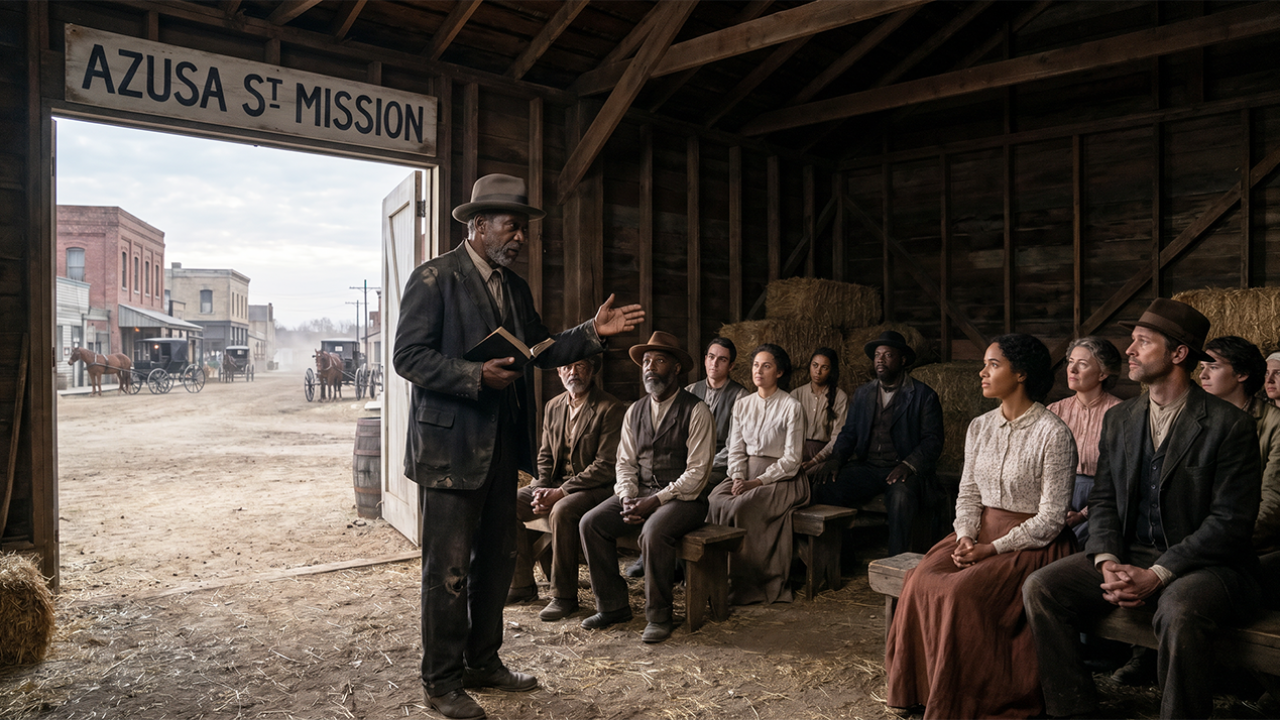
This is Article 6 in the Series: Know What You Believe and Why - KNOW YOUR ROOTS: A Plain-Language Guide to the Major Christian Traditions
Title: Pentecostal — Fire, Spirit, and the Gifts
The Movement Nobody Saw Coming
On April 9, 1906, a Black preacher named William J. Seymour stood in front of a small group of people in a converted stable on Azusa Street in Los Angeles and began to preach. What happened over the next three years at that address — 312 Azusa Street — is one of the most debated and most consequential events in modern Christian history.
People spoke in tongues. People were reportedly healed. Crowds came from across the country and around the world. Newspapers covered it, mostly with mockery. Theologians debated it, mostly with suspicion. And the movement that grew out of it — Pentecostalism — became the fastest-growing segment of Christianity in the 20th century.
Today there are an estimated 600 million Pentecostal and charismatic Christians worldwide. That is not a footnote. That is roughly a quarter of all Christians on earth. Whatever you think of the theology, you cannot understand the global church in the 21st century without understanding what Pentecostals believe and why so many people have found it compelling.
The Theological Core
Pentecostal theology is built on a specific reading of the New Testament — particularly the book of Acts — and a specific claim about what that reading means for Christians today.
The foundational event is Pentecost itself. Acts 2 describes the disciples gathered in Jerusalem fifty days after the resurrection when the Holy Spirit descended on them with wind and fire, and they began to speak in other languages. Peter stood up and preached, and three thousand people were added to the church that day.
Pentecostals argue that this event was not just a one-time historical occurrence. It was a pattern — a normative experience available to every believer. The baptism of the Holy Spirit, evidenced by speaking in tongues, is a distinct experience from conversion, available to and intended for every Christian. The gifts of the Spirit described in 1 Corinthians 12 — tongues, prophecy, healing, miracles — are not limited to the apostolic age. They are active today.
This is the central claim, and it is the one that divides Pentecostals from most of the rest of Protestant Christianity. The cessationist position — held by most Reformed and many Baptist theologians — argues that the miraculous gifts ceased with the death of the apostles, having served their purpose of authenticating the apostolic message. The continuationist position — held by Pentecostals and charismatics — argues that there is no biblical warrant for that cessation and that the gifts are still active.
This is a genuine theological debate with serious people on both sides. It is not resolved by dismissing one side as either superstitious or unspiritual.
What Pentecostals Get Right
The Pentecostal tradition has recovered something that much of Western Christianity had lost: the expectation that God is actively present and actively working in the lives of believers. The cessationist tradition, taken to its logical extreme, produces a Christianity where God spoke in the past, the Bible records what He said, and the Christian life is essentially the application of ancient texts to modern circumstances. God is real but distant. Prayer is important but its results are uncertain. The Holy Spirit is a doctrine, not an experience.
That is not the picture the New Testament paints. The New Testament describes a community of people who expected God to show up — who prayed with expectation, who saw the Spirit move in visible ways, who lived with a sense of divine presence and divine power that was immediate and personal.
Whether or not you accept the Pentecostal theology of tongues and spiritual gifts, the instinct that God is present and active — that prayer is not just a spiritual discipline but a genuine conversation with a God who responds — is correct. The Pentecostal tradition has kept that expectation alive in ways that much of the rest of the church has not.
The Pentecostal missionary record is also remarkable. The movement has grown fastest in the Global South — in Africa, Latin America, and Asia — precisely because it presents a Christianity that is experiential, communal, and expectant. In contexts where people are accustomed to spiritual power being real and present, a Christianity that offers the living God rather than a set of propositions about the living God has enormous appeal.
Where It Gets Complicated
The Pentecostal tradition has a serious accountability problem. The emphasis on direct spiritual experience — on personal revelation, on the immediate voice of the Spirit — creates a framework that is difficult to check against Scripture. If a pastor claims to have received a word from God, who challenges it? If a prophecy fails to come true, how is that handled? The history of Pentecostalism is littered with failed prophecies, financial scandals, and spiritual abuse enabled by leaders who claimed direct divine authority.
The prosperity gospel — the teaching that faith produces financial blessing and physical health, and that poverty and sickness are signs of insufficient faith — emerged primarily from the Pentecostal and charismatic world. It is not representative of all Pentecostal theology, and many serious Pentecostal theologians have condemned it. But it has done enormous damage, particularly in the Global South, where it has exploited poor and desperate people with promises that Scripture does not make.
The tongues debate also deserves honest engagement. The Pentecostal claim that speaking in tongues is the initial physical evidence of Spirit baptism — that every Spirit-filled believer will speak in tongues — is a specific theological claim that requires specific biblical support. The texts most often cited — Acts 2, Acts 10, Acts 19 — describe tongues occurring in specific contexts. Whether those contexts establish a universal normative pattern is a legitimate exegetical question, and the honest answer is that the biblical case is not as clear as Pentecostal theology requires it to be.
The Charismatic Distinction
One clarification worth making: Pentecostalism and the charismatic movement are related but distinct. Classical Pentecostalism refers to denominations like the Assemblies of God and the Church of God in Christ that emerged from the Azusa Street revival and similar early 20th century movements. The charismatic movement refers to the renewal of spiritual gifts within mainline Protestant and Catholic churches beginning in the 1960s. Neo-charismatic or Third Wave movements emerged in the 1980s and 1990s.
All three share the continuationist conviction that spiritual gifts are active today. They differ in ecclesiology, in how they understand Spirit baptism, and in their relationship to historic denominational structures. If you are engaging someone from this broad tradition, knowing which stream they are in matters.
Practical Applications
Do not dismiss the expectation of divine presence. Whatever your position on spiritual gifts, the Pentecostal instinct that God is actively present and that prayer produces real results is worth holding onto. A Christianity that has lost the expectation of divine action is a Christianity that has lost something essential.
Engage the cessationism debate honestly. If you hold a cessationist position, be able to defend it from Scripture rather than from tradition or discomfort. If you hold a continuationist position, be able to articulate the biblical case and acknowledge the genuine exegetical questions. This is a debate worth having carefully.
Apply the 1 Corinthians 14 standard. Whatever you believe about spiritual gifts, Paul's instructions in 1 Corinthians 14 are clear: everything in the church should be done for edification, in order, and subject to evaluation. "The spirits of prophets are subject to the control of prophets." Any spiritual experience that cannot be evaluated, questioned, or tested against Scripture is a spiritual experience that should be treated with caution.
Watch the accountability structures. In any church that emphasizes direct spiritual experience and personal revelation, the accountability structures matter enormously. A pastor whose authority rests on claimed divine communication rather than demonstrated character and biblical fidelity is a pastor worth watching carefully.
The Closing Charge
The Azusa Street revival happened in a converted stable, led by a man who had been turned away from other churches, attended by people from every race at a time when American society was rigidly segregated. Whatever you think of the theology, the image is worth sitting with: the Spirit moving in the margins, among the people nobody expected, in a place nobody would have chosen.
That is a very New Testament picture. The Pentecostal tradition, at its best, has kept that picture alive — the expectation that God shows up, that He moves, that He is not confined to the respectable and the institutional.
At its worst, it has produced manipulation, exploitation, and a Christianity built on experience rather than truth. The antidote, as always, is the Word. Experience tested by Scripture. Expectation grounded in promise. Fire that does not burn down the house.
Stop Drifting
You already know what happens if you do nothing.
A year from now,
you’ll either: